Federal government sets 2026–2029 roadmap for constitutional implementation as political uncertainty deepens following disputes over presidential term limits and constitutional amendments.
MOGADISHU, Mogadishu (Horn post) The Cabinet of the Federal Government of Somalia on Sunday approved a national roadmap to implement the country’s constitution between 2026 and 2029, in a move officials described as critical to strengthening state institutions, political stability and national unity.
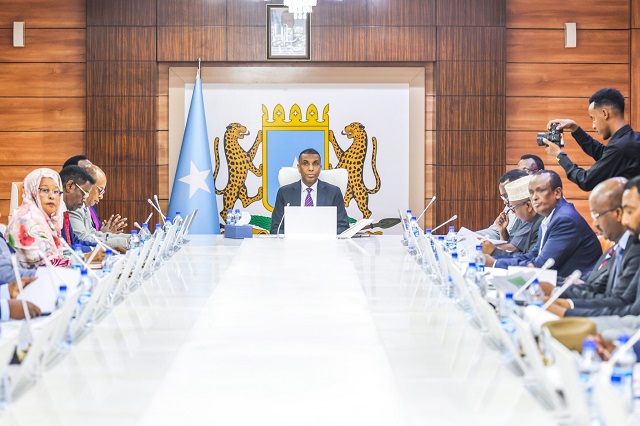
During the cabinet meeting, chaired by Prime Minister Hamza Abdi Barre, the Ministry of Justice and Constitutional Affairs presented the framework, timeline and technical procedures for implementing key constitutional provisions over the next four years.
Officials said the implementation plan is designed to ensure that all constitutional articles are enforced within the timeframe outlined in the constitution, with priority reforms scheduled for the next 12 months, including the establishment of major state institutions such as the Judicial Service Council and the National Revenue Authority.
Prime Minister Barre told ministers that the constitution became legally effective following presidential ratification and official publication, while its full administrative and institutional implementation would require a phased technical process.
The cabinet also reviewed reports on recent one-person, one-vote local elections held in the Southwest State, updates on ongoing political consultations led by President Hassan Sheikh Mohamud, and the role of state media in electoral coverage.
In a separate decision, ministers approved the promotion of Mohamed Rabiic Yusuf, currently serving as deputy head of Somalia’s mission to the United Nations in New York, to the rank of ambassador.
The cabinet also endorsed several national policies, agreements and regulations aimed at economic and institutional development, including a national sports development policy, social insurance reforms, an investment protection agreement with Saudi Arabia, an updated education cooperation agreement with Turkey, and governance regulations for district councils in the Banaadir region.
The cabinet’s approval of the constitutional implementation plan comes amid growing political tensions in Somalia following unresolved disputes over constitutional amendments and the presidential term, which opposition figures say expired on May 15. Political negotiations backed by international partners have so far failed to produce a consensus, leaving uncertainty over the country’s political roadmap.
Prepared by:
Horn post staff
info@hornpost.com
www.hornpost.com
News Desk Hargeisa