

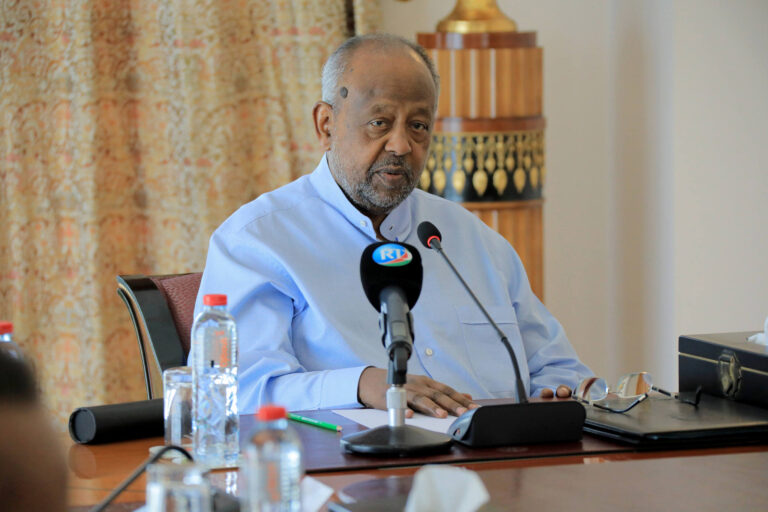
Djibouti City (Horn post) — The Prsident of republic of Djibouti Ismaïl Omar Guelleh convened senior government officials on Sunday for a second high-level meeting in less than two weeks to assess the economic fallout from the ongoing conflict in the Middle East, with a particular focus on rising prices and supply chain pressures.
The meeting, held at the presidential palace in Djibouti City, comes amid continued global uncertainty linked to the prolonged conflict involving Iran and its broader impact on international energy and logistics markets.
According to a statement from the presidency, the session reviewed the implementation of an initial action plan aimed at cushioning the effects of external shocks on Djibouti’s import-dependent economy. Officials discussed potential revisions to domestic pricing structures, taking into account updated international freight costs and evolving market conditions.
At the center of the discussions was a proposal to establish a dedicated interministerial “task force” to manage and anticipate external economic crises. The body is expected to include representatives from both the public and private sectors to enhance coordination and improve response mechanisms to market disruptions.
“The objective is to prevent any uncontrolled surge in prices, particularly for essential goods and domestic fuel,” a government source said, emphasizing increased monitoring of supply chains and distribution networks.
Authorities are prioritizing measures to shield vulnerable populations as inflationary pressures mount, driven largely by geopolitical tensions. In Djibouti, where the economy heavily relies on imports, fluctuations in global shipping and energy costs tend to quickly translate into higher consumer prices.
The meeting was attended by Prime Minister Abdoulkader Kamil Mohamed, along with ministers responsible for the economy, foreign affairs, trade, infrastructure, energy, and social affairs.
Also present were Mohamed Abdillahi Waiss, Secretary-General of the Presidency, and Aboubaker Omar Hadi, head of the Djibouti Ports and Free Zones Authority.
The presidency said the series of consultations underscores the government’s intent to proactively address the risks posed by a prolonged international crisis and to limit its impact on the daily lives of Djiboutian citizens.
Prepared by: Horn Post Staff
Contact: info@hornpost.com
Website: www.hornpost.com