KISMAYO, Somalia (HornPost) – Somalia’s political divisions came into sharp focus in Kismayo on Monday as regional leaders and opposition figures challenged President Hassan Sheikh Mohamud’s proposed electoral roadmap.
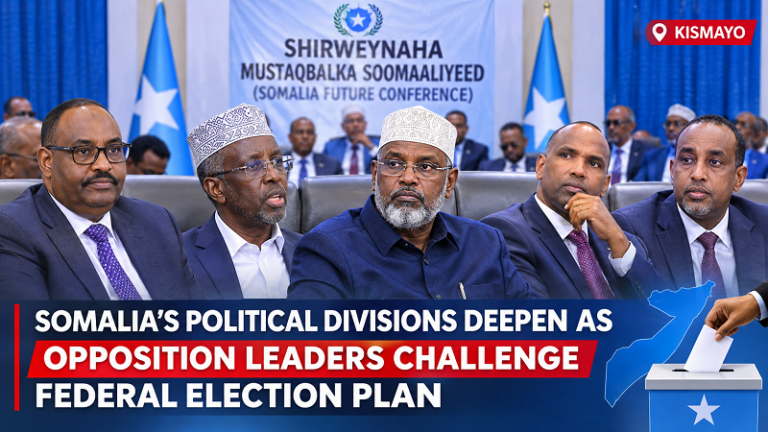
The leaders gathered at Kismayo Guest House for the Somalia Future Conference. They discussed the country’s political direction, electoral arrangements and the future of its federal system.
However, disagreements over the proposed election model dominated the meeting. Opposition figures argued that the federal government must secure broad political support before introducing major changes to the electoral process.
Among the participants were Puntland President Said Abdullahi Deni and Jubaland President Ahmed Mohamed Islam, widely known as Ahmed Madobe.
Former President Sheikh Sharif Sheikh Ahmed also attended, alongside former Prime Ministers Hassan Ali Khaire, Mohamed Hussein Roble and Abdi Farah Shirdon, known as Saacid. Opposition lawmaker Abdirahman Abdishakur Warsame and several other politicians also joined the conference.
Opposition Leaders Question Federal Election Plan
At the center of the dispute is the opposition’s criticism of President Hassan Sheikh Mohamud’s proposed electoral roadmap.
Critics say the plan gives too much authority to the federal government and the national electoral commission. They also argue that it could weaken the role of federal member states in decisions about national elections.
Opposition leaders insist that Somalia’s federal structure requires consultation between the central government and regional administrations. They warn that unilateral decisions could deepen political divisions.
Puntland President Said Abdullahi Deni delivered one of the strongest criticisms during the conference.
“It is unconstitutional and unlawful to tell federal member states to step aside while one authority claims full control. Somalia is a federal state, not a centralized one,” Deni said.
He also stressed that major political decisions require agreement among the country’s federal institutions and member states.
Madobe Calls for Genuine Political Consultation
Jubaland President Ahmed Mohamed Islam said the disagreement should not be viewed as a personal dispute with the president.
Instead, he described it as a political disagreement over the country’s national interests and the credibility of its electoral process.
“I do not oppose President Hassan Sheikh as an individual. Our disagreement is about Somali interests. Elections cannot be credible if they are designed and managed without genuine consultation,” Madobe told the conference.
His remarks reflected the wider concerns raised by opposition leaders over the need for an electoral agreement that includes regional administrations and other political stakeholders.
Former President Warns Against Political Division
Former President Sheikh Sharif Sheikh Ahmed urged political leaders to protect the progress Somalia has made through years of state-building.
Addressing President Hassan Sheikh Mohamud, he warned against decisions that could create further divisions.
“Xasanoow, this country has been rebuilt piece by piece over many years. Do not scatter it again through decisions that divide Somalis,” Sheikh Sharif said.
He emphasized the importance of dialogue, compromise and shared responsibility in resolving the country’s political disagreements.
Electoral Commission and Federalism at the Center of Dispute
Other speakers, including former prime ministers and opposition lawmakers, raised concerns about the independence of the electoral commission.
They questioned whether the proposed arrangements could ensure a credible and widely accepted election. Some also warned that political disagreements could lead to a prolonged institutional crisis.
The debate reflects wider tensions over the division of powers between Somalia’s federal government and its member states.
While President Hassan Sheikh Mohamud’s administration has presented electoral reforms as part of its efforts to advance democratic governance, opposition leaders say the process must begin with broad consultation and political agreement.
They argue that an election framework will struggle to gain public confidence if major political stakeholders reject the arrangements.
Political Disagreements Raise Concerns Over Stability
Somalia continues to face major challenges in its state-building process. These include unresolved constitutional questions, security threats and disagreements over the relationship between federal institutions and regional administrations.
Consequently, political disputes over elections could affect cooperation between government institutions. They could also distract leaders from other national priorities, including counterterrorism, economic recovery and humanitarian needs.
The Kismayo conference has therefore placed renewed attention on the need for dialogue between the federal government, regional leaders and opposition groups.
Participants called for a negotiated electoral framework that respects the federal system and gives political stakeholders a meaningful role in shaping the country’s future.
However, it remains unclear whether the meeting will produce an agreement with the federal government.
The discussions in Kismayo have nevertheless highlighted the depth of Somalia’s political divisions and the challenges facing efforts to reach a national consensus on elections.
HornPost Staff Reporter
info@hornpost.com
www.hornpost.com