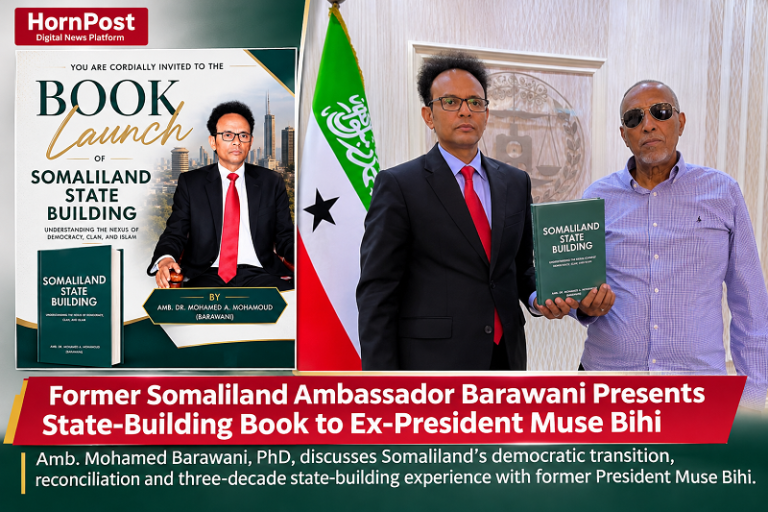
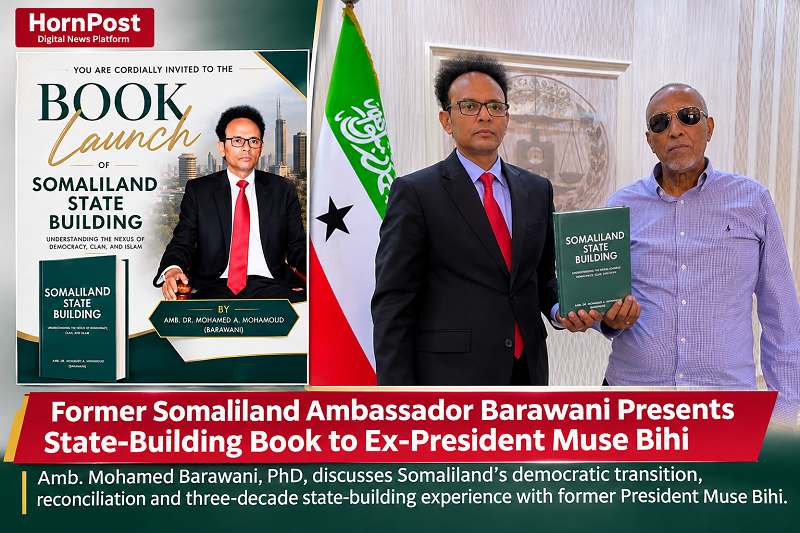
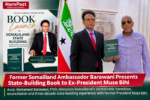
Ambassador Mohamed Barawani, PhD, discusses Somaliland’s reconciliation, democratic transitions and state-building experience with former President Muse Bihi Abdi, highlighting lessons he says could benefit post-conflict countries across Africa.
HARGEISA, Somaliland (HornPost) – Former Somaliland Ambassador to Kenya Mohamed Barawani, PhD, has presented his newly published book on Somaliland’s state-building and peace process to former President Muse Bihi Abdi, who appointed him to represent Somaliland in Kenya during his administration.
Barawani recently launched the book in Hargeisa with title “Somaliland State Building” before presenting a copy to the former president, whose leadership tenure included the ambassador’s diplomatic appointment.
In a statement following their meeting, Barawani described the encounter as an honor and said they discussed Somaliland’s political history, reconciliation process and the development of its state institutions since the restoration of its sovereignty in 1991.
According to Barawani, Muse Bihi shared his first-hand experiences of Somaliland’s state-building journey, including the transition from the Somali National Movement (SNM) liberation struggle to the declaration of Somaliland’s independence in May 1991.
The discussions also examined the political and institutional experiences that have shaped Somaliland over more than three decades.
SNM’s Role in Somaliland’s Democratic Tradition
Barawani highlighted the Somali National Movement’s historical role in developing a culture of political competition and leadership rotation, arguing that its internal democratic practices helped lay the foundations for Somaliland’s subsequent political system.
He said the SNM elected and re-elected several chairpersons between 1981 and 1990, describing the movement’s leadership changes through internal competition as an important example of democratic practice within an African liberation movement.
According to Barawani, the movement’s decision to transfer power to civilian leadership in 1993 further contributed to Somaliland’s political development.
He argued that this experience distinguished the SNM from several other African liberation movements, which he said struggled to relinquish political authority after achieving their objectives.
Peaceful Transfer of Power and Democratic Development
The former ambassador also pointed to Somaliland’s record of peaceful presidential transitions as an important achievement in its state-building process.
He noted that, for the second time since 2010, an incumbent Somaliland president had accepted an election result and peacefully transferred power to a successor.
Barawani described the development as relatively uncommon in parts of Africa and particularly significant in East Africa, where political disputes over elections and presidential terms have contributed to instability in several countries.
He contrasted Somaliland’s experience with continuing political challenges in Somalia, arguing that disagreements over constitutional arrangements, presidential mandates and electoral frameworks have undermined efforts to establish a stable democratic system.
His remarks also highlighted the importance of constitutionalism, political consensus and respect for electoral outcomes in sustaining democratic institutions.
Somaliland as a Model for Post-Conflict State-Building
Barawani said Somaliland’s experience had attracted attention from scholars, researchers and international institutions examining reconciliation, post-conflict reconstruction and democratic governance.
He argued that Somaliland offers lessons for other African countries and societies emerging from conflict, particularly in the areas of peacebuilding, institutional reconstruction, disarmament and demobilization, constitutional development and democratization.
He also highlighted Somaliland’s efforts to reconcile traditional clan structures, Islamic values and democratic institutions within a single political framework.
According to Barawani, the ability to bring these different social and political traditions together has been central to Somaliland’s reconciliation and state-building process.
He maintained that other post-conflict societies could draw lessons from Somaliland’s experience in negotiating political settlements, rebuilding public institutions and establishing mechanisms for peaceful political competition.
A Continuing Debate on Somaliland’s Political Experience
Somaliland’s state-building experience has remained a subject of academic and diplomatic interest, particularly because of its locally driven reconciliation process and the development of functioning political institutions since 1991.
The presentation of Barawani’s book to former President Muse Bihi provides another opportunity to reflect on the historical experiences, political decisions and institutional developments that have shaped Somaliland’s three-decade journey.
The meeting also brought together two figures connected through Somaliland’s diplomatic and political history, with Barawani having served as ambassador to Kenya under Muse Bihi’s administration.
HornPost Staff Reporter
Email: info@hornpost.com
Website: https://hornpost.com