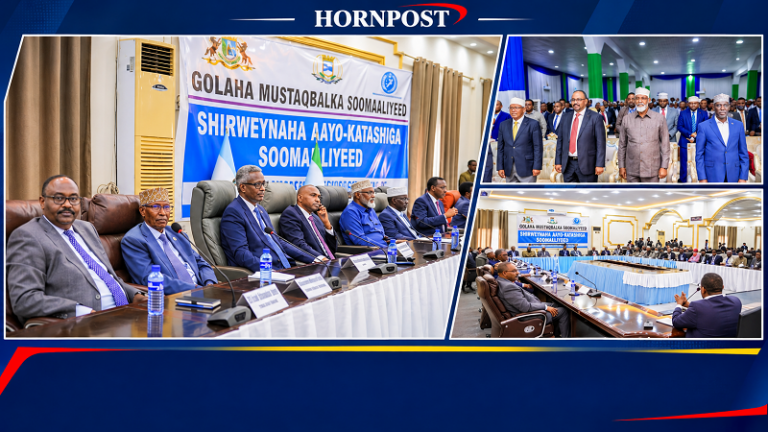
KISMAYO, Somalia (Horn Post) — Somalia’s Somali Future Council has rejected any extension of the mandates of federal political institutions and called for inclusive, transparent and timely elections, warning that unilateral political decisions could deepen the country’s constitutional and security crisis.
The council issued the warning in a strongly worded communiqué following a three-day political conference in Kismayo, held from December 18 to 20, 2025. The gathering brought together senior political leaders, current and former government officials, members of the Federal Parliament and civil society representatives.
Participants used the conference to assess Somalia’s political direction, constitutional disputes, security situation and economic challenges. They also raised concerns about forced displacement, alleged corruption and the management of public land.
Somali Future Council Accuses Federal Government of Governance Failures
In its final communiqué, the Somali Future Council accused President Hassan Sheikh Mohamud’s administration of failing to address major political, security and economic challenges.
The council argued that government policies have deepened political divisions and weakened confidence in federal institutions.
It also accused the administration of making unilateral constitutional changes and undermining institutions responsible for maintaining a balance of power within the federal system.
Furthermore, the communiqué criticized the federal government’s relationship with Federal Member States, alleging that political disagreements and disputes over constitutional mandates have weakened cooperation between the federal and regional administrations.
The council called for respect for constitutional procedures and greater political consultation on decisions affecting the country’s future.
Opposition Rejects Any Extension of Political Mandates
The question of presidential and parliamentary mandates emerged as one of the central issues at the Kismayo conference.
According to the December 2025 communiqué, the council maintained that the Federal Parliament’s mandate would expire on April 14, 2026, while President Hassan Sheikh Mohamud’s term would end on May 15, 2026.
The participants rejected any attempt to extend those mandates without an agreed constitutional and electoral framework.
They warned that unilateral extensions could create a constitutional vacuum, increase political tensions and undermine national stability.
The council also called for elections that would be more transparent, inclusive and representative than the 2022 electoral process.
It emphasized the need for political consensus, fair representation and an electoral commission accepted by the country’s political stakeholders.
President Given One Month to Convene National Dialogue
The conference called on President Hassan Sheikh Mohamud to convene an inclusive meeting of political stakeholders within one month, setting January 20, 2026, as the proposed deadline.
The proposed dialogue was intended to produce an agreement on the electoral model, constitutional arrangements and the timetable for the country’s next political transition.
The council warned that failure to respond to its proposal could lead it to pursue alternative political and electoral arrangements.
It said such measures would aim to prevent a constitutional vacuum and avoid further deterioration in the country’s political and security situation.
The demand reflected growing disagreements between the federal government and opposition figures over how Somalia should organize its elections and manage the transfer of political authority.
Banadir Electoral Process Faces Opposition Criticism
The communiqué also challenged the ongoing electoral process in the Banadir region, which includes Mogadishu.
The Somali Future Council described the process as one-sided and argued that it lacked sufficient political consensus.
It further questioned the constitutional and legal framework governing elections in the capital, citing the unresolved political status of Mogadishu.
The council argued that decisions concerning Banadir’s political representation should involve broader consultation and respect the constitutional rights of residents.
The disagreement reflects wider divisions over the electoral system and the federal government’s efforts to introduce a one-person, one-vote model.
Security Concerns and Fight Against Al-Shabaab
The council accused the federal administration of neglecting national security priorities and weakening the operational capacity of the Somali National Army through alleged corruption, favoritism and political interference.
It also expressed concern about the morale, discipline and welfare of security personnel.
The communiqué called for renewed efforts against Al-Shabaab and ISIS, while praising Somali security forces for their sacrifices in defending the country.
Participants stressed that national security institutions should operate professionally and remain focused on protecting citizens and defending the country.
Forced Displacement and Sale of Public Land Condemned
The conference also raised concerns about the reported forced displacement of vulnerable communities and the alleged illegal sale of public land.
The council accused government authorities of allowing practices that have affected poor families and weakened public confidence in state institutions.
It called for an immediate halt to forced evictions and the sale of public assets without appropriate legal procedures.
The communiqué also highlighted concerns about corruption, the business environment and the treatment of domestic and foreign investors.
According to the council, these challenges have contributed to economic uncertainty, discouraged investment and worsened the difficulties facing vulnerable communities.
The participants further called for greater protection of independent media and civil society organizations, warning against restrictions on freedom of expression and civic participation.
Senior Political Leaders Attend Kismayo Conference
The conference attracted several prominent Somali political figures, including leaders from the Federal Member States and former federal government officials.
Those attending the closing session included:
Ahmed Mohamed Islam (Ahmed Madobe), president of Jubaland.
Said Abdullahi Deni, president of Puntland.
Sharif Sheikh Ahmed, former president of Somalia.
Hassan Ali Khaire, former prime minister.
Abdi Farah Shirdon (Saacid), former prime minister.
Mohamed Hussein Roble, former prime minister.
Members of the Federal Parliament, opposition politicians and civil society representatives.
Their participation highlighted the importance of the gathering as a platform for discussing Somalia’s political future and the disagreements surrounding the country’s electoral arrangements.
Appeal to International Partners
The Somali Future Council also called on international partners to continue supporting Somalia’s political stability, security institutions and democratic development.
It urged international stakeholders to support an electoral process based on transparency, political agreement and constitutional principles.
The council also expressed concern about the humanitarian difficulties facing Somali communities at home and abroad, calling for greater attention to vulnerable populations.
At the conclusion of the conference, participants thanked the Jubaland government and people for hosting the gathering and facilitating the discussions.
Somalia Faces Continued Political and Constitutional Disagreements
The Kismayo conference underscored the depth of political disagreements between the federal government and opposition figures over constitutional amendments, elections and the future of Somalia’s federal system.
Although the council called for dialogue, its communiqué also signaled the possibility of alternative political arrangements if negotiations failed.
The central challenge remains reaching an electoral agreement that commands broad political support and provides a credible framework for national representation.
Horn Post Staff Reporter
Hargeisa, Somaliland
info@hornpost.com
www.hornpost.com