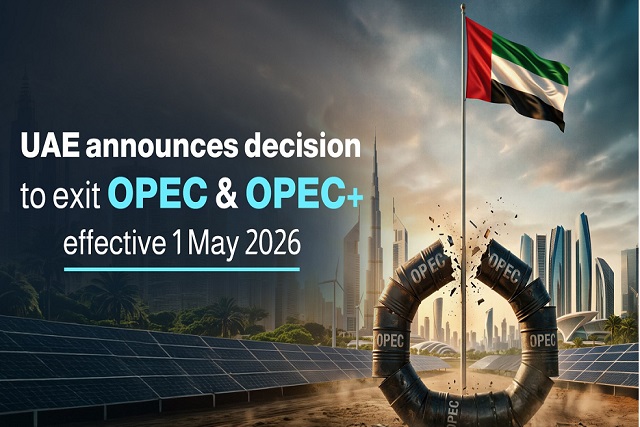
ABU DHABI (Horn post) — The United Arab Emirates announced Tuesday it will withdraw from the Organization of the Petroleum Exporting Countries and the broader OPEC+ alliance effective May 1, marking a major shift in its energy policy after nearly six decades of membership.
The decision reflects the UAE’s long-term strategic vision and evolving energy profile, including expanded domestic production capacity and increased investment across oil, gas, and renewable sectors, according to an official statement released in Abu Dhabi.
Officials said the move followed a comprehensive review of production policy, current output levels, and future capacity planning, emphasizing that the withdrawal aligns with national economic priorities and the country’s commitment to meeting global energy demand efficiently.
Strategic Realignment Amid Market Pressures
The UAE cited ongoing volatility in global energy markets — including disruptions in the Arabian Gulf and the Strait of Hormuz — as a key factor shaping supply dynamics. Despite short-term uncertainty, the country expects sustained growth in global energy demand over the medium and long term.
“A stable global energy system depends on flexible, reliable, and affordable supply,” the statement said, adding that the UAE’s policy shift will enhance its ability to respond more independently to market conditions.
The Gulf state, one of the world’s largest oil producers, joined OPEC in 1967 through Abu Dhabi before becoming part of the federation established in 1971. Since then, it has played a significant role in coordinating output policies aimed at stabilizing global oil markets.
Continued Commitment to Market Stability
Despite exiting the alliance, the UAE stressed it will remain a “reliable and responsible” energy supplier, continuing to bring additional production to market gradually and in line with demand.
The country also highlighted its position as a producer of relatively low-carbon crude, noting its intention to support both global economic growth and emissions reduction goals.
Officials said the decision would not undermine cooperation with other producers or consumers but instead provide greater flexibility in addressing shifting market needs.
Investment and Energy Transition Focus
The UAE reaffirmed plans to expand investments across the full energy value chain, including hydrocarbons, renewables, and low-carbon technologies, as part of a broader diversification strategy.
The government emphasized that it would maintain active engagement with global partners while pursuing a more autonomous production framework.
“We value more than five decades of cooperation,” the statement said, expressing appreciation for OPEC and OPEC+ efforts while signaling a pivot toward policies driven primarily by national interest.
Market Implications
The UAE’s departure could have significant implications for global oil supply coordination, as OPEC+ has been central to managing output levels in recent years. Analysts say the move may introduce additional uncertainty into production agreements and pricing strategies, particularly if other producers reconsider their positions.
Prepared by:
Horn post staff
info@hornpost.com
www.hornpost.com