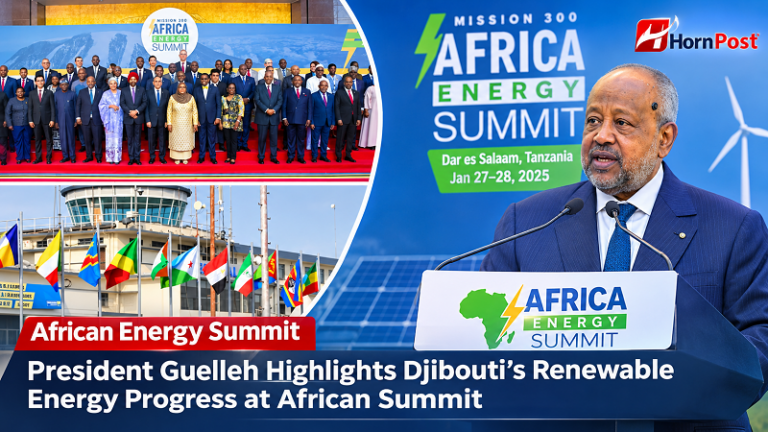
DAR ES SALAAM (Hornpost) — Djibouti President Ismail Omar Guelleh has highlighted his country’s progress in renewable energy and called for stronger international support for Africa’s energy transition.
President Guelleh delivered the remarks during the Mission 300 Africa Energy Summit, held in Dar es Salaam, Tanzania, on January 27–28, 2025.
He returned to Djibouti on Tuesday evening after attending the two-day summit, which brought together African leaders, international financial institutions and energy sector representatives.
The African Union, the World Bank and the African Development Bank supported the event alongside the Tanzanian government. Discussions focused on expanding electricity access and attracting investment in Africa’s energy sector.
Guelleh Highlights Djibouti’s Renewable Energy Progress
During his address, President Guelleh presented Djibouti’s efforts to increase the use of clean and renewable energy.
He said renewable sources account for approximately 85 percent of Djibouti’s energy supply.
The president highlighted several projects supporting this progress. They include the Goubet wind farm, electricity imports from Ethiopia through a hydroelectric interconnection and a planned solar power plant in Grand Bara.
He also pointed to government reforms designed to attract private investment and improve electricity production.
These measures include public-private partnerships and opening the electricity market to independent power producers.
President Guelleh said renewable energy remains central to Djibouti’s energy security and economic development.
President Calls for Greater International Financial Support
The Djiboutian leader also raised concerns about the financing challenges facing African countries.
He argued that governments across the continent need substantial financial resources to develop reliable and sustainable energy systems.
Guelleh called on international partners to honour their financial commitments and provide practical support for Africa’s energy transition.
He stressed that African countries face specific economic and climate challenges. These require stronger international cooperation and access to affordable financing.
He also called for a fairer international economic system that considers the development priorities of African nations.
African Leaders Endorse Mission 300 Energy Declaration
The summit concluded with the adoption of the Dar es Salaam Energy Declaration.
African leaders committed to expanding access to electricity for 300 million people across the continent by 2030.
The initiative, known as Mission 300, aims to address Africa’s electricity shortage through infrastructure investment, policy reforms and stronger partnerships.
According to the World Bank and African Development Bank, more than 600 million people in Africa lacked access to electricity at the time of the summit.
International partners also pledged more than $50 billion to support the initiative.
The declaration focuses on expanding electricity networks, promoting clean energy and creating opportunities for economic growth and employment.
Guelleh Promotes Djibouti’s Candidate for AU Commission Chair
On the sidelines of the summit, President Guelleh held bilateral meetings with several African leaders.
His discussions included meetings with the presidents of Somalia, Comoros and Zambia.
The leaders discussed bilateral relations, regional cooperation and issues affecting the African continent.
Guelleh also used the meetings to promote Djibouti’s candidate for chairperson of the African Union Commission, Foreign Minister Mahamoud Ali Youssouf.
He highlighted the candidate’s diplomatic experience and qualifications ahead of the African Union election scheduled for February 2025.
The campaign formed part of Djibouti’s diplomatic engagement during the summit.
Djibouti Reaffirms Commitment to Clean Energy
President Guelleh’s participation in the summit highlighted Djibouti’s renewable energy plans and its interest in wider African energy cooperation.
The country continues to pursue projects involving wind, solar, geothermal and hydropower.
Djibouti aims to expand domestic electricity production and strengthen its energy security through regional partnerships.
The government also views renewable energy investment as an opportunity to support industrial development, create jobs and reduce dependence on conventional energy sources.
The president’s return on January 28 marked the conclusion of Djibouti’s participation in the two-day Mission 300 summit.
Hornpost Staff Reporter
info@hornpost.com