




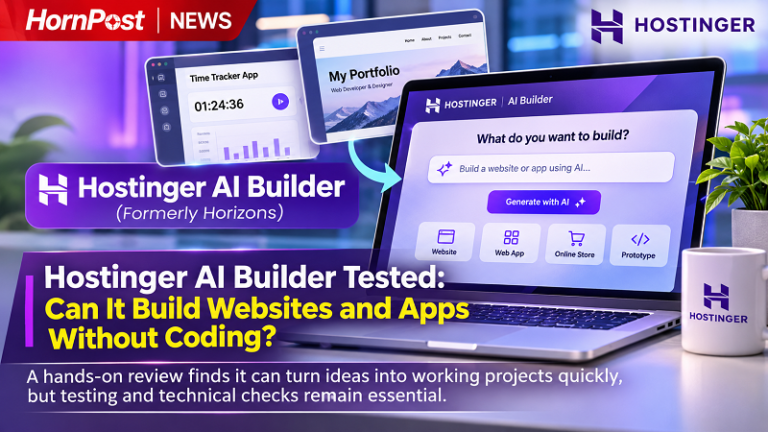
A hands-on review finds the AI tool can turn ideas into working prototypes quickly, but technical testing remains essential before launching a finished product.
TECHNOLOGY | HornPost — Artificial intelligence is changing how people build websites and software, making it possible for users with little or no coding experience to develop digital products.
Hostinger’s AI-powered development platform is among the tools targeting this growing market. Originally launched as Hostinger Horizons in March 2025, the service allows users to describe their ideas in everyday language and have artificial intelligence generate websites and browser-based applications.
Hostinger later renamed the product Hostinger AI Builder in August 2026, combining its previous Horizons technology with its website-building services. The platform continues to attract attention from entrepreneurs, small businesses, bloggers and developers looking for faster ways to create digital projects.
A recent hands-on review by technology publication WPShout examined the platform by building two projects: a time-tracking application with advanced features and a one-page website with interactive scrolling effects.
The results highlighted both the potential of AI-assisted development and the technical challenges users may encounter.
Building an App Without Writing Code
The first experiment involved creating a time-tracking application designed to help users manage working hours, clients, projects and invoices.
The application included a dashboard displaying information from different sections, alongside a timer that allowed users to start, pause and end work sessions.
It also included options to add clients, assign hourly rates, manage projects and generate invoices. Users could customize invoices with business information and export them as PDF files.
According to WPShout’s review, the AI builder produced an attractive initial design without requiring detailed instructions about colors, fonts or layout.
The reviewer also used additional prompts to correct some early problems and develop more features.
However, further testing exposed problems with the application’s core time-tracking function. Although the timer appeared to work, it failed to record elapsed time accurately when the user switched to another browser tab.
In one test, approximately one hour passed, but the application recorded only nine minutes.
The reviewer also found problems with information appearing incorrectly on the dashboard. These issues showed why an application that looks functional during an initial demonstration may still require extensive testing.
Rebuilding a Website With AI
The second experiment focused on recreating a one-page portfolio website with interactive scrolling effects.
The reviewer provided screenshots and design references to help the AI understand the desired layout and visual appearance.
The process involved generating website sections, adding scrolling effects and replacing placeholder images and links with the original site’s content.
WPShout reported that the reviewer completed the reconstruction using 16 prompts.
The resulting website included desktop and mobile layouts. Although the recreated effects were not identical to the original design, the reviewer considered the outcome visually appealing.
Some minor problems required additional prompts, but most were resolved during the process.
The experiment demonstrated how AI website builders can reduce the time required to develop a website prototype, particularly when users provide clear instructions and visual references.
What Are the Main Advantages?
One of Hostinger AI Builder’s main advantages is its conversational approach.
Users do not need to begin by writing code or configuring a complicated development environment. Instead, they describe what they want to build, and the platform generates the initial project.
The platform also supports image and screenshot uploads, allowing users to provide visual references for their projects.
Other features include:
- Natural-language development: Users describe website or application requirements through prompts.
- Visual references: Screenshots and images can guide the design process.
- Website creation: Users can build business websites, landing pages, portfolios and online stores.
- Web applications: The platform supports browser-based tools such as dashboards, productivity applications and management systems.
- Code access: Users can inspect or export generated project files.
- Integrated hosting: Projects can be published through Hostinger’s hosting environment.
Hostinger says its platform supports more than 80 languages and can generate the code and backend structure needed for web projects. <Cite refs={[“turn931669search1″,”turn931669search2”]}/>
Limitations and Technical Challenges
Despite its advantages, Hostinger AI Builder is not a complete replacement for professional software development.
The WPShout review identified problems with application functionality, particularly when a project required accurate data processing and more complex interactions.
The platform also has limitations for developers who want to manage projects through conventional development tools.
For example, the review identified the lack of GitHub integration as a disadvantage. It also noted that projects requiring backend integrations could be more difficult to configure.
Hostinger’s documentation confirms that users may need additional technical steps to connect external databases and authentication services. It recommends services such as Supabase for some backend requirements.
The platform also does not currently create native applications for Apple’s App Store or Google Play. Its primary focus is websites and browser-based applications. <Cite refs={[“turn931669search0″,”turn931669search8”]}/>
These limitations mean users should not assume that an AI-generated application is ready for public use simply because its design looks complete.
Testing security, data storage, user authentication, payments and other essential functions remains important before launching a commercial product.
Who Can Benefit From Hostinger AI Builder?
The platform may be useful for people who want to turn an idea into a website or working prototype without hiring a developer immediately.
Small business owners can use it to create business websites and landing pages. Entrepreneurs can experiment with digital products, while bloggers and freelancers can develop portfolio websites.
Developers may also benefit from using AI to speed up early development and reduce the time spent building initial layouts and prototypes.
However, projects involving complex databases, sensitive information, financial transactions or advanced integrations may require professional technical support.
Is the Technology Worth Considering?
The WPShout experiments suggest that Hostinger’s AI development platform can produce useful results in a relatively short time.
The time-tracking application demonstrated its ability to generate complex-looking interfaces and multiple features. The portfolio experiment showed how screenshots and prompts can help recreate website layouts.
However, the timer errors also highlighted a critical distinction between visual quality and reliable functionality.
AI tools can accelerate development, but users still need to test their projects carefully and understand their technical requirements.
For beginners, the platform offers an accessible starting point. For experienced developers, it can serve as a productivity tool for building prototypes and exploring ideas.
Ultimately, its usefulness depends on the complexity of the project and the user’s expectations.
The technology makes website and application development more accessible, but human oversight and proper testing remain essential.
HornPost Technology Desk
Prepared by:
HornPost staff
HornPost Authors
HornPost Staff is the editorial byline of HornPost.com, used for collaborative newsroom reporting, editorial content, and reports published by the Horn Post editorial team. HornPost covers Somaliland, the Horn of Africa, Africa, the Middle East, and major international developments, with reporting focused on politics, governance, diplomacy, security, business, economics, and breaking news. HornPost is committed to accurate, fair, independent, and responsible journalism.