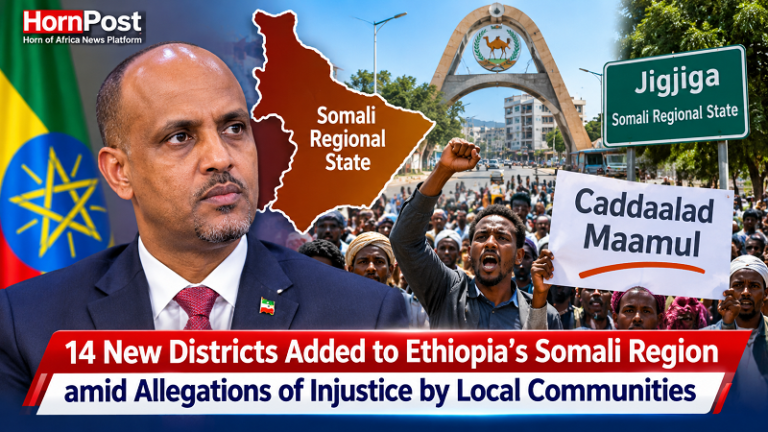
JIGJIGA, Ethiopia (HornPost) — The Somali Regional State of Ethiopia has approved the creation of 14 new administrative districts, increasing the region’s total from 95 to 109, according to the regional announcement.
The decision was approved by the Somali Regional State Council on July 27, 2025, as part of a wider administrative restructuring plan. The changes also included four new zonal administrations and 25 municipal leadership offices.
However, the decision triggered protests and political criticism in several parts of the Somali Region and neighbouring Oromia. Some communities have questioned the fairness of the new administrative arrangements. They argue that the government has failed to distribute administrative recognition equally among the region’s different communities.
Communities Raise Concerns Over Unequal Representation
Some communities, particularly those in the areas commonly known as the Reserve areas of the Somali Region, have expressed dissatisfaction with the restructuring.
They accuse regional authorities of favouring certain communities when allocating new administrative districts and other government structures.
Critics have also questioned the leadership of regional President Mustafe Muhumed Omar, widely known as Mustafe Cagjar. They allege that communities with longstanding demands for district or regional status have received limited recognition.
Some critics argue that the distribution of administrative benefits has favored the Ogaden community, from which the regional president comes.
They describe the decision as part of a wider pattern of political and administrative inequality. They have also criticized the regional parliament for approving the changes without adequately addressing longstanding grievances.
These allegations reflect concerns raised by sections of the region’s population. However, they do not represent an independently established finding of discrimination.
Protests Spread to Neighboring Oromia Region
The administrative restructuring also triggered opposition in neighboring Oromia Region, which shares a long and sensitive boundary with the Somali Region.
Protests were reported in several towns, particularly in Borana and East Borana areas. Demonstrators expressed concern that the new administrative arrangements could affect disputed territories and existing regional boundaries.
The Oromo Liberation Front (OLF) also criticized the decision. It called on the federal government to intervene and address the dispute before further tensions lead to civilian casualties.
The controversy has renewed concerns about the relationship between administrative restructuring, territorial disputes and ethnic tensions in Ethiopia.
Longstanding Border Disputes Add to Tensions
The Somali and Oromia regions have experienced recurring disputes over land, grazing areas and administrative boundaries.
These tensions have occasionally escalated into violent clashes, resulting in deaths, displacement and damage to relations between neighboring communities.
The two regions share one of Ethiopia’s longest internal boundaries. Disagreements over local administration and territorial control have remained major sources of political tension.
The latest controversy has therefore raised concerns that administrative changes could further complicate efforts to maintain peace along the border.
Analysts and community representatives have stressed the importance of consultation, dialogue and federal mediation when addressing sensitive administrative questions.
Somali Regional Government Defends the Restructuring
The Somali Regional Government has defended the administrative changes, describing them as an internal restructuring exercise intended to improve governance and public service delivery.
Mohammed Adam, head of the region’s Communication Bureau, told Addis Standard that the changes were strictly internal and did not involve redrawing administrative boundaries.
However, the explanation has not ended opposition to the decision. Critics continue to demand greater consultation with affected communities and a fairer distribution of administrative representation.
The controversy highlights the challenges facing Ethiopia’s ethnic federal system, particularly in areas where administrative boundaries, community representation and local political interests overlap.
Federal Government Faces Calls to Address the Dispute
The protests and political reactions have increased pressure on Ethiopia’s federal government to help resolve disagreements between the Somali and Oromia regions.
Community representatives and political groups have called for inclusive dialogue involving regional authorities, traditional elders and residents of affected areas.
They argue that administrative restructuring should take local concerns into account and should not deepen existing divisions.
The central challenge remains how to balance local governance reforms with the need to protect community interests, maintain territorial stability and prevent further conflict.
As debate over the restructuring continues, the response of federal authorities and the willingness of regional leaders to engage affected communities will be important in determining whether the changes contribute to better administration or deepen existing tensions.
HornPost Staff Reporter
admin@hornpost.net
www.hornpost.com