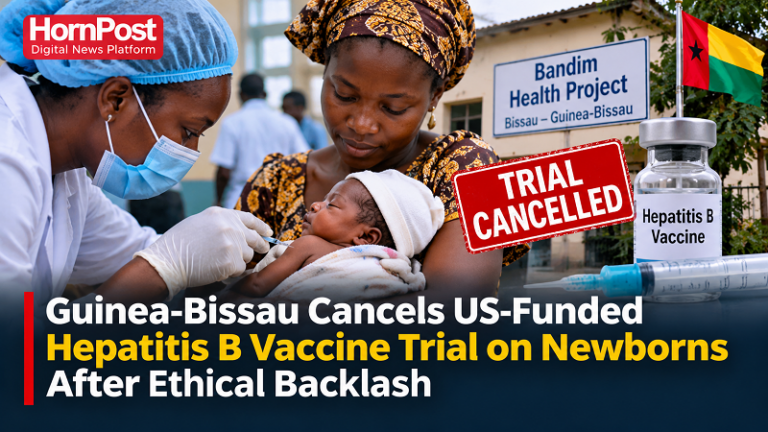
BISSAU, Guinea-Bissau (HornPost) – Guinea-Bissau has cancelled a controversial US-funded hepatitis B vaccine trial involving 14,000 newborn babies following international criticism over its ethical implications.
The proposed study faced strong opposition from public health experts and the World Health Organization (WHO). Critics argued that the research would deny half of the participating newborns a vaccine that the WHO recommends at birth.
The controversy also raised concerns about medical research in vulnerable African communities and whether similar experiments would be considered acceptable in wealthier countries.
The US government funded the proposed research through the Centers for Disease Control and Prevention (CDC), which awarded $1.6 million to the University of Southern Denmark in December 2025.
Police also searched the Bandim Health Project research center in the capital, Bissau, on October 19 and seized a batch of hepatitis B vaccines.
What Was the Proposed Vaccine Trial?
The study was planned at the Bandim Health Project, a research center that has operated in Guinea-Bissau since 1978.
Researchers planned to recruit 14,000 newborns and divide them into two groups. One group would receive the hepatitis B vaccine shortly after birth, while the other would receive it at six weeks, following the country’s existing vaccination schedule.
The researchers wanted to investigate whether giving the vaccine at birth has broader effects on infant health beyond preventing hepatitis B infection.
They also cited previous studies in The Gambia and Guinea-Bissau that raised questions about possible links between vaccination and other health outcomes.
However, critics questioned the decision to delay vaccination for half of the newborns. They argued that the design could expose vulnerable infants to an avoidable risk of infection.
WHO Raises Ethical Concerns
The World Health Organization expressed serious concerns about the proposed research.
Walter Kazadi Mulombo, the WHO representative in Guinea-Bissau, told the BBC that the organization became concerned after receiving questions about the study and finding no publicly available research protocol.
He said the main ethical issue was the decision to withhold a vaccine that has already demonstrated its effectiveness in protecting newborns.
The hepatitis B vaccine has been used for more than 30 years in over 115 countries, according to the WHO representative.
The organization recommends that all newborns receive their first hepatitis B vaccine dose within 24 hours of birth.
Hepatitis B Remains a Public Health Challenge
Hepatitis B is a viral infection that attacks the liver. It can cause both short-term and chronic health problems.
People infected during infancy face a particularly high risk of developing chronic hepatitis B. Long-term infection can lead to liver failure and liver cancer.
According to data cited in the BBC report, nearly one-fifth of Guinea-Bissau’s population is infected with the virus.
The country currently administers the hepatitis B vaccine at six weeks of age rather than immediately after birth. The WHO says the delay leaves newborns less protected against infection transmitted during childbirth.
Guinea-Bissau had previously planned to introduce routine birth-dose vaccination in 2028. However, health officials are considering bringing forward the program to the first quarter of 2027.
Government Rejects the Research Project
Guinea-Bissau’s government prohibited hepatitis B vaccine trials involving children in January 2026 and requested assistance from the Africa Centers for Disease Control and Prevention to assess the proposed study.
The country’s Council of Ministers reaffirmed its rejection of the project on October 16.
Three days later, judicial police searched the Bandim Health Project’s facilities and seized a batch of vaccines intended for the proposed research.
Frederik Schaltz-Buchholzer, a researcher involved in the project, subsequently confirmed that the study would not proceed because it had not received the necessary government approval.
The University of Southern Denmark has maintained that its own research ethics committee had reviewed the proposal. However, the university acknowledged that its internal assessment did not replace the required approval from Guinea-Bissau.
Researchers described the cancellation as a setback for African scientific research, while critics welcomed the government’s decision.
Wider Debate Over Medical Research in Africa
The controversy has raised broader questions about research ethics, international funding and the protection of vulnerable populations.
Some public health experts described the proposed trial as neocolonial, arguing that African newborns should not face research risks that would be unacceptable in wealthier countries.
Others questioned why researchers chose Guinea-Bissau for the study instead of conducting similar research in countries with stronger healthcare systems and established birth-dose vaccination programs.
The debate has also drawn attention to the responsibility of international research institutions to obtain proper government approval and protect participants.
The proposed trial never started. According to the researchers, no babies were enrolled and no vaccines were administered as part of the study.
The US Department of Health and Human Services had not publicly responded to the BBC’s request for comment at the time of its report.
HornPost Staff Reporter
Email: info@hornpost.com
Website: https://hornpost.com